
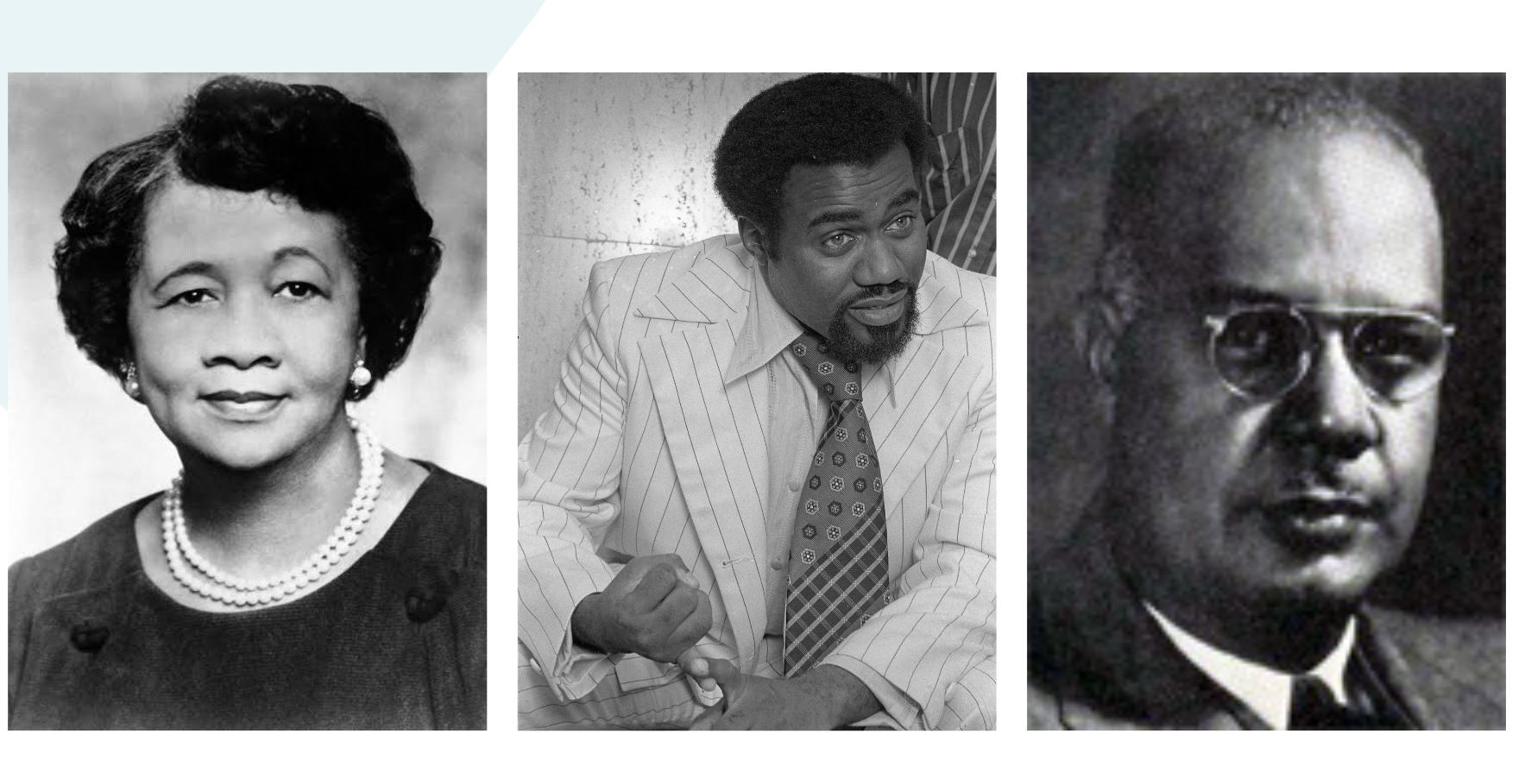
This month, as we recognize Black History Month, we honor the contributions and lived experiences of Black individuals and communities. This month, we invite you to learn about the Black social workers who have helped shape our profession.
Meet Dorothy Haight, Cenie “Jomo” Williams, Jr., and Lester Blackwell Granger.
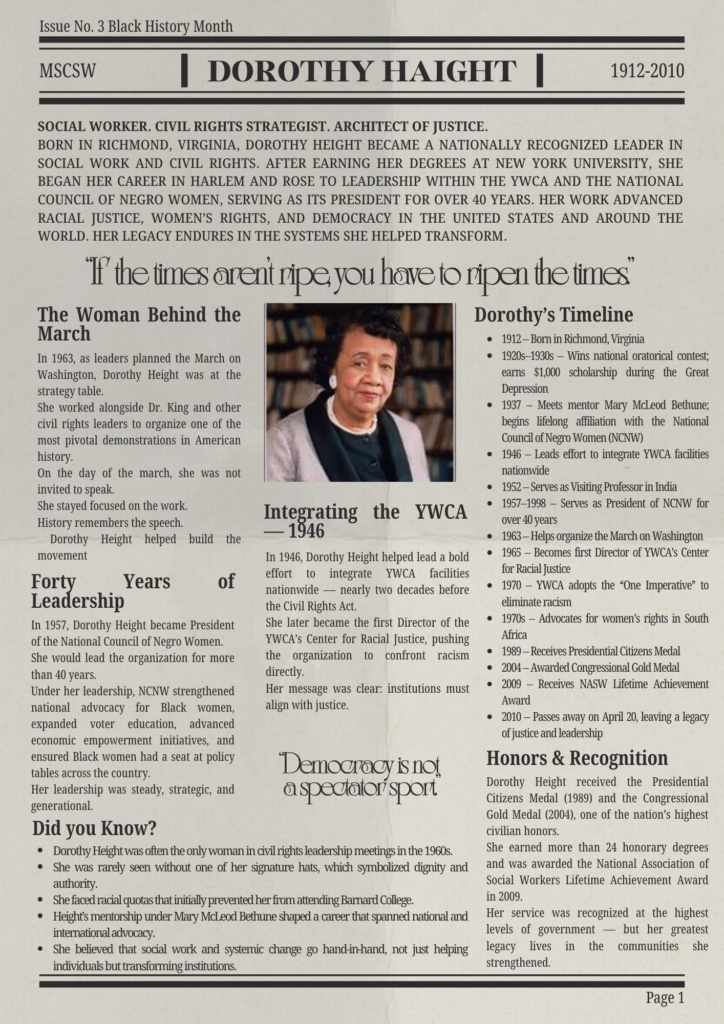
Meet Dorothy Haight
Born in Richmond, Virginia, Dorothy Height became a nationally recognized leader in social work and civil rights. After earning her degrees at New York University, she began her career in Harlem and rose to leadership within the YWCA and the National Council of Negro Women, serving as its president for over 40 years. Her work advanced racial justice, women’s rights, and democracy in the United States and around the world. Her legacy endures in the systems she helped transform.
“If the times aren’t ripe, you have to ripen the times”
In 1963, as leaders planned the March on Washington, Dorothy Height was at the strategy table. She worked alongside Dr. King and other civil rights leaders to organize one of the most pivotal demonstrations in American history. On the day of the march, she was not invited to speak. She stayed focused on the work. History remembers the speech. Dorothy Height helped build the movement.
Forty Years of Leadership
In 1957, Dorothy Height became President of the National Council of Negro Women. She would lead the organization for more than 40 years.
Under her leadership, NCNW strengthened national advocacy for Black women, expanded voter education, advanced economic empowerment initiatives, and ensured Black women had a seat at policy tables across the country.
Her leadership was steady, strategic, and generational.
Did you know?
• Dorothy Height was often the only woman in civil rights leadership meetings in the 1960s.
• She was rarely seen without one of her signature hats, which symbolized dignity and authority.
• She faced racial quotas that initially prevented her from attending Barnard College.
• Height’s mentorship under Mary McLeod Bethune shaped a career that spanned national and international advocacy.
• She believed that social work and systemic change go hand-in-hand, not just helping individuals but transforming institutions.
Integrating the YWCA, 1946
In 1946, Dorothy Height helped lead a bold effort to integrate YWCA facilities nationwide, nearly two decades before the Civil Rights Act. She later became the first Director of the YWCA’s Center for Racial Justice, pushing the organization to confront racism directly. Her message was clear: institutions must align with justice. “Democracy is not a spectator sport”
Dorothy’s Timeline
• 1912 — Born in Richmond, Virginia
• 1920s–1930s — Wins national oratorical contest; earns $1,000 scholarship during the Great Depression
• 1937 — Meets mentor Mary McLeod Bethune; begins lifelong affiliation with the National Council of Negro Women (NCNW)
• 1946 — Leads effort to integrate YWCA facilities nationwide
• 1952 — Serves as Visiting Professor in India
• 1957–1998 — Serves as President of NCNW for over 40 years
• 1963 — Helps organize the March on Washington
• 1965 — Becomes first Director of YWCA’s Center for Racial Justice
• 1970 — YWCA adopts the “One Imperative” to eliminate racism
• 1970s — Advocates for women’s rights in South Africa
• 1989 — Receives Presidential Citizens Medal
• 2004 — Awarded Congressional Gold Medal
• 2009 — Receives NASW Lifetime Achievement Award
• 2010 — Passes away on April 20, leaving a legacy of justice and leadership
Honors & Recognition
Dorothy Height received the Presidential Citizens Medal (1989) and the Congressional Gold Medal (2004), one of the nation’s highest civilian honors.
She earned more than 24 honorary degrees and was awarded the National Association of Social Workers Lifetime Achievement Award in 2009.
Her service was recognized at the highest levels of government but her greatest legacy lives in the communities she strengthened.
Meet Cenie “Jomo” Williams, Jr.
Mr. Williams was born in South Carolina, and received his undergraduate degree from South Carolina State College, and his Master of Social Work degree from New York University.
Mr. Williams was a tireless activist, fighting for justice and affordable housing. In 1967, Mr. Williams helped to found the National Association of Black Social Workers to ensure the Black experience was tended to in social work. Mr. Williams served as NABSW president for several years as well as its Executive Director, until his untimely death in 1983. He was instrumental in starting NABSW chapters throughout the Western Hemisphere.
We laud Mr. Williams’ work for his community, and for safeguarding space for Black voices in social work.
Meet Lester Blackwell Granger
To begin, meet Lester Blackwell Granger. Mr. Granger was born in Newport News, VA in 1897 but spent most of his childhood in New Jersey. After pursuing an undergraduate degree at Dartmouth and a Master of Social Work from New York University School of Social Work, he began his social work career as an extension worker. He served as Executive Director of the National Urban League from 1941 – 1961.
During and after WWII, Mr. Granger worked to end discrimination and segregation in the armed forces and in defense jobs, earning the President’s Medal for Merit. Among his many other accomplishments, he led efforts to unionize Black workers, and to increase their educational opportunities.
Mr. Granger served as Vice President of the American Association of Social Workers (a precursor to NASW) and on the Board of the Council of Social Work Education. To learn more about Lester Granger, visit the NASW Foundation website linked below. We are grateful for his contributions to our nation and our field!