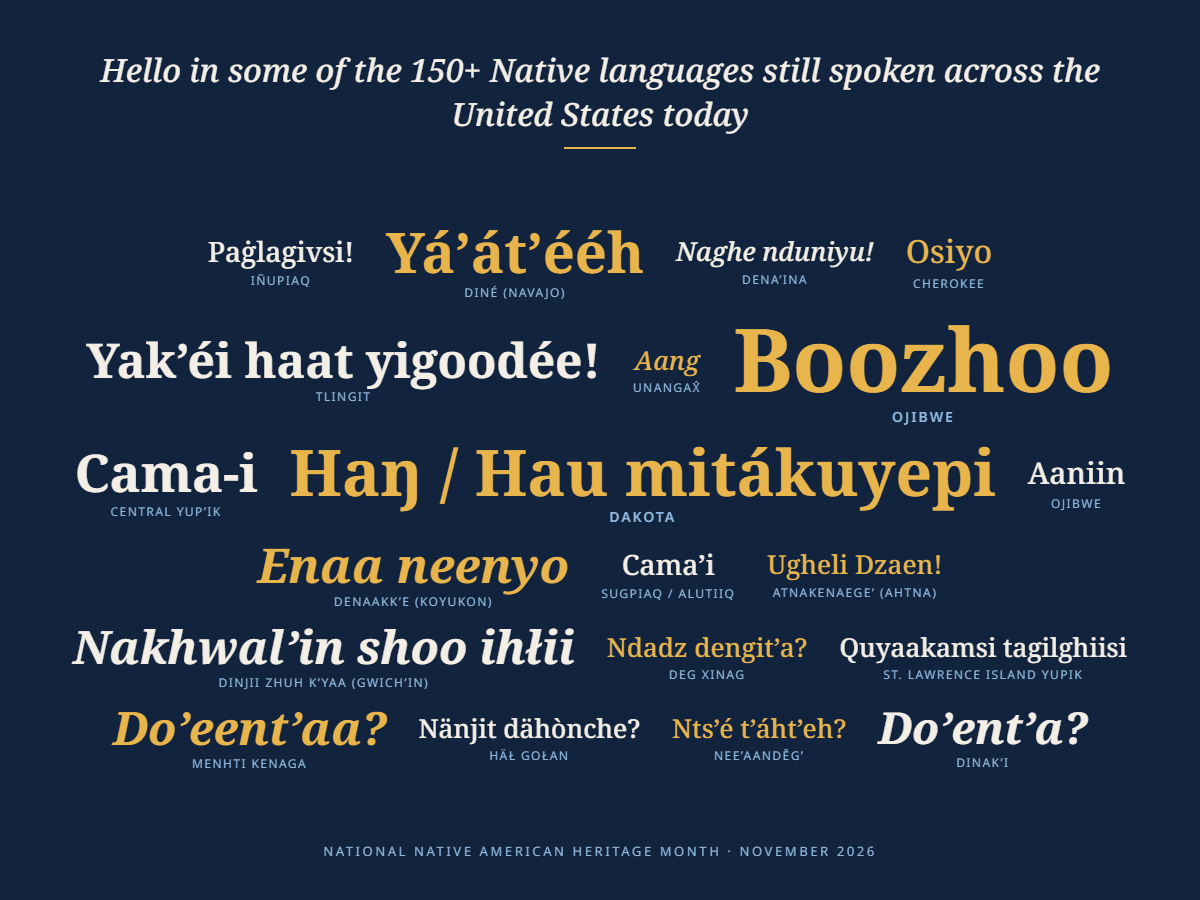
Boozhoo, Haŋ mitákuyepi, and hello in each of the more than 150 Native languages still spoken across this country today.
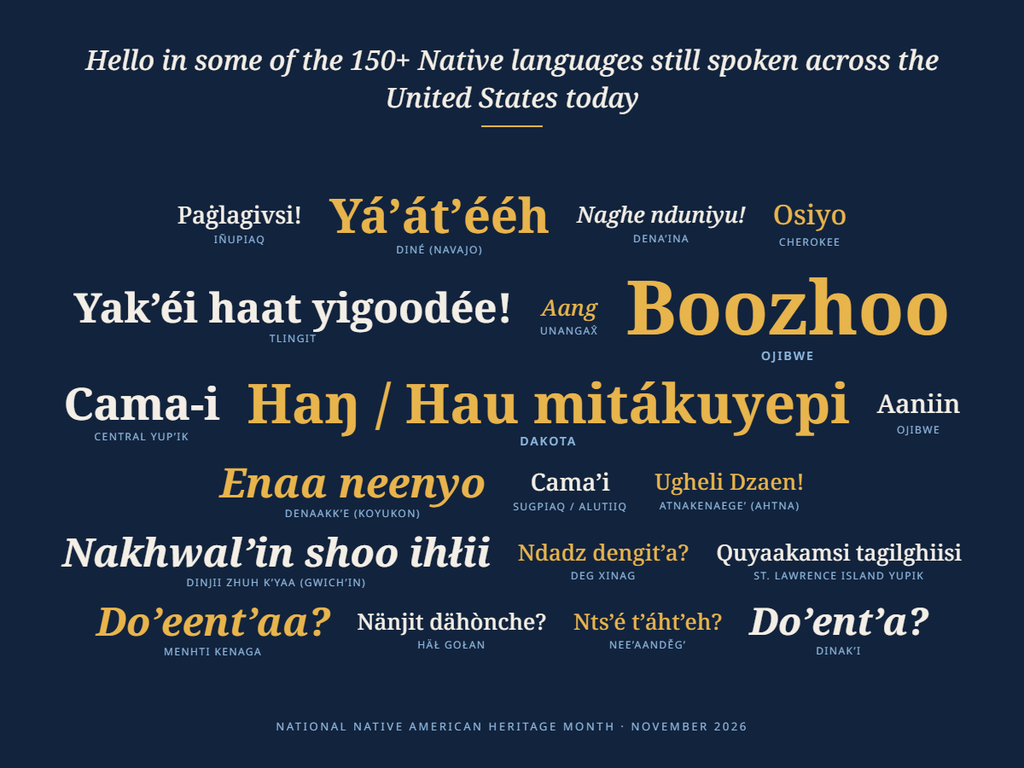
Before Europeans showed up, more than 300 Indigenous languages were spoken across North America. Boarding schools and forced assimilation wiped out a lot of them. Kids were actually punished for speaking their own languages. But more than 150 are still spoken today, and Native communities are working hard to bring even more back.
Here in Minnesota, the main languages of this land are Dakota and Ojibwe. Boozhoo (boo-ZHOO) is a common Ojibwe greeting, and Haŋ mitákuyepi means “Hello, my relatives” in Dakota (women say Haŋ, men say Hau). Lots of Native relatives from other nations live here too, so you might also hear Lakota, Ho-Chunk, Diné and more.
I want to be upfront: I’m not Native. I’m a descendant of European immigrants, living and working on Dakota land, and I’m still learning. Everything I’m sharing comes from Native-led and official sources, so if I get something wrong, please let me know!
November is National Native American Heritage Month. It’s been recognized nationally since 1990, and Native American Heritage Day is the Friday after Thanksgiving. I’ll be sending a few emails this month to honor the Dakota, Anishinaabe, and all Native relatives in our community, and to share some ways we can learn and take action together.
This email: where we STAND.
But first, what a historic week. On November 3, Native women made history at nearly every level of government:
- Peggy Flanagan (White Earth Nation, Ojibwe), our own Senator-elect, is the first Native American woman ever elected to the U.S. Senate.
- Deb Haaland (Laguna Pueblo) is the first Native American woman elected governor of any state (New Mexico).
- Crystalyne Curley is the first woman elected president of the Navajo Nation (results aren’t final).
- Tina Abrams is the first woman elected president of the Seneca Nation.
- Claire Valdez (Ysleta del Sur Pueblo) is the first Native American elected to represent New York in Congress.
- Sharice Davids (Ho-Chunk) was re-elected to the U.S. House from Kansas.
- Mary Peltola (Yup’ik), the first Alaska Native elected to Congress, is running for U.S. Senate in Alaska. The race hasn’t been called yet. If she wins, she’ll be the first Alaska Native elected to the U.S. Senate.
WHOSE LAND ARE YOU ON RIGHT NOW?
- Dakota people: southern Minnesota, including the Twin Cities. This is Mni Sota Makoce, “the land where the waters reflect the skies.”
- Anishinaabe people (Ojibwe or Chippewa): much of northern Minnesota.
Meet all 11 nations through the Minnesota Indian Affairs Council: https://mn.gov/indian-affairs/
A land acknowledgment reminds us that Native people aren’t just part of history. They’re still here, on their homelands, today. It also tells the truth: these lands were taken through treaties that tribal leaders were pressured into signing, and the U.S. broke many of those promises. Still, treaties matter today. They recognize tribes as nations that govern themselves. That said, the Native Governance Center in St. Paul has an important caution: an acknowledgment alone isn’t enough. It’s a starting point, and it should lead to action.
You can share an acknowledgment at the start of meetings, trainings and groups, or add one to your email signature, slides, onboarding materials or our website.
TRY THIS ONE (adapt it to the land you’re on; if you’re in northern Minnesota, name the Anishinaabe nation whose homeland you’re on):
“We are gathered on Dakota homeland, Mni Sota Makoce. We honor the Dakota people, and the Anishinaabe and other Native relatives who live here today. We commit to [one specific action].” Want to write your own? Start here: https://nativegov.org/a-guide-to-indigenous-land-acknowledgment/
PLACES TO VISIT AND LEARN (Minnesota Historical Society)
- Our Home: Native Minnesota at the Minnesota History Center, St. Paul: https://www.mnhs.org/historycenter/activities/museum/our-home
- Mille Lacs Indian Museum & Trading Post, Onamia: https://www.mnhs.org/millelacs
- Bdote at Historic Fort Snelling: https://www.mnhs.org/fortsnelling/learn/bdote
- The U.S.-Dakota War of 1862 (online): https://www.mnhs.org/usdakotawar
WORD OF THE WEEK
Gashkadino-giizis (Ojibwe): November, the “Freezing Over Moon.” Hear it spoken by an Ojibwe speaker: https://ojibwe.lib.umn.edu/main-entry/gashkadino-giizis-na
Want a new word every day? Follow Dr. Anton Treuer (Ojibwe), professor of Ojibwe at Bemidji State University. https://www.facebook.com/antontreuer/reels/
YOUR CHALLENGE THIS WEEK
Look up whose homeland your own home is on, then open one meeting this week with a land acknowledgment and one action you’ll take.
In the next email, we’ll explore our profession’s history with Native families in Minnesota: the harm, the progress, and how we help repair it, including in the therapy room.
Miigwech (thank you),
Tia Wilcek
President, MSCSW
I live and work in White Bear Lake, on Dakota homeland. I honor the Dakota people, who are still here today, and all Native relatives who call Minnesota home. As a social worker, I commit to honoring my clients’ cultural and family connections, learning Dakota and Ojibwe from Native teachers, and supporting the Native-led organizations that keep these communities strong.